Sixty years on the register.
On the anniversary of our 1963 application to the Charity Commission, a short history of how a parish trust became a registered almshouse charity, and what changed (and what did not) along the way.
Written by The Reverend Henry Linton, Honorary Almoner
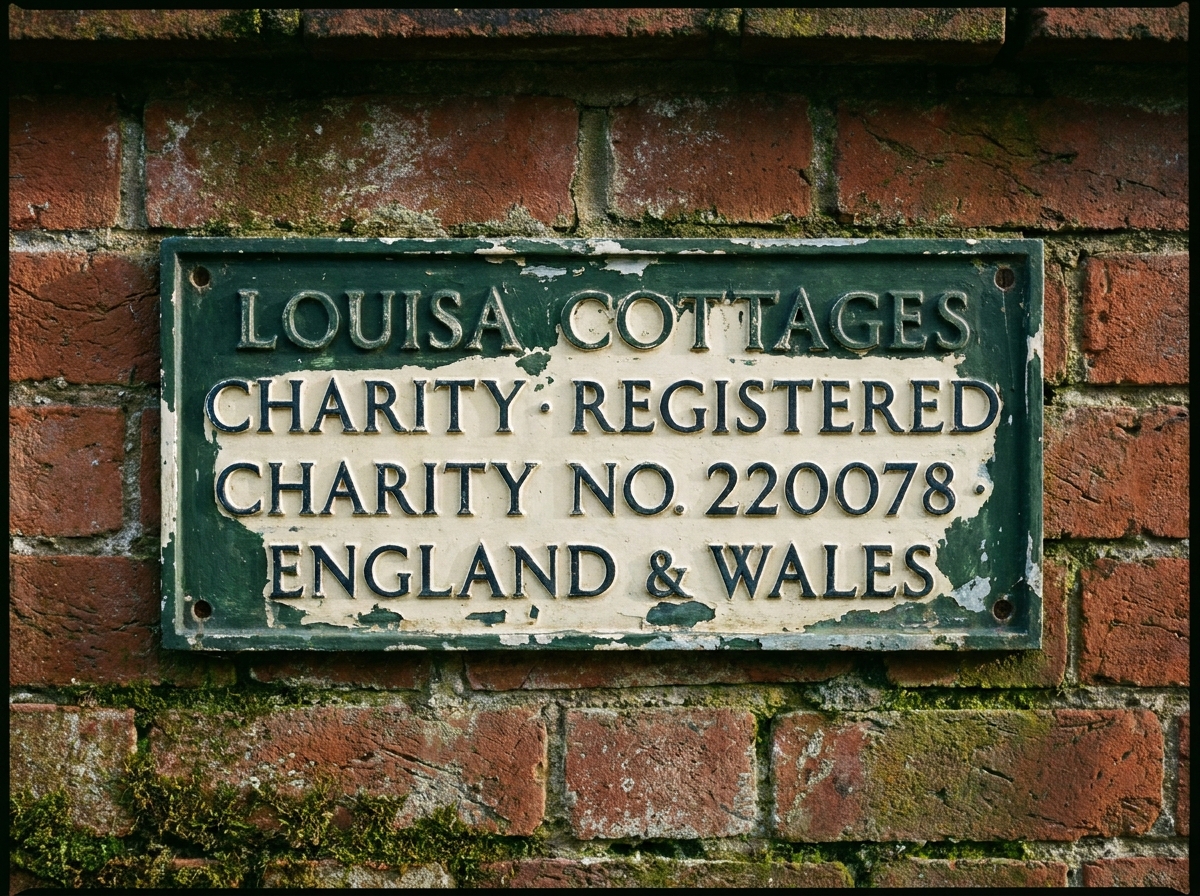
On the third of July 1963, the parish trust that ran the Louisa Cottages submitted an application to the Charity Commissioners for England and Wales for entry on the new register of charities. The application was accepted in the usual course. We were given the number 220078, which we have carried, plainly, on every official letter and every annual report since.
The cottages themselves were older than the registration by a comfortable margin. Local records suggest a small endowment of cottages was made for the relief of older parishioners somewhere in the nineteenth century. The names ‘Louisa’ and ‘cottages’ appear in the parish papers from the 1880s onwards. The exact founding moment is not preserved — this is the case for many small almshouse trusts of similar age. What is clearly preserved is that, by 1962, the parish was running the cottages under an informal trusteeship, that the trustees were ageing, and that the Charity Commission’s 1960 reforms required a formal application from any charity wishing to remain on the proper footing.
What 1963 meant in practice
Registration in 1963 did three things for the cottages. It established a public, retrievable identity. It tied the trustees to a single, unambiguous charitable object. And it placed the trust within a system of annual reporting that we have observed without a break for sixty-two years.
The charitable object — to manage the almshouses at Tring and to apply income for repairs and for the benefit of the almspeople — was lifted, with only the lightest editing, from the wording of the parish’s informal articles. It has not been amended since. We resist the temptation to revise it from time to time, on the grounds that any modern phrasing would lose more than it would gain.
Sixty-two years of paper
The clerk’s office holds a complete run of the annual reports back to 1963. They are bound in fawn card and stored in a single deep drawer of the roll-top desk. The earliest are typewritten on tissue-thin paper; from 1986 onwards they are word-processed; from the mid-2000s they are also held digitally.
To read them through is to read the history of a small, mostly steady set of accounts — income from weekly contributions in the order of a few thousand pounds in the 1960s, growing in line with inflation and prices, and expenditure tracking it with a margin of a few thousand pounds either way. The big lines — the 1971 bathrooms, the 1985 first written safeguarding policy, the 2008 co-regulation by what is now Homes England, the 2021 north-range slates — appear as small bumps in the spending lines, but the overall shape of the accounts is one of careful, almost-unchanging steadiness.
If you read sixty years of accounts through in a single sitting, the impression is not of progress. The impression is of continuity, week after week, slate after slate, kettle after kettle.
What changed, and what did not
What changed, between 1963 and 2026: the cottages got modern bathrooms; gas central heating replaced a coal-fired boiler in the south range; the trustees adopted, year by year, the various written policies expected of small charities (safeguarding, complaints, conflicts of interest, financial reserves, internal financial controls, serious incident reporting); the Sunday Doors befriending rota was set up in 1997; the Winter Hearth grant began in 2008; the website you are reading was put together in 2025 by a friend of the trust in Berkhamsted, in his evenings.
What did not change: the cottages are still six. The residents are still mostly women in their seventies and eighties. The clerk still answers the post by hand. The kettle is still in the same place in the common room. The catalogue is still in pencil. The bench is still reachable.
The 2063 question
We are unlikely to be the people who write the hundredth-anniversary note in 2063. That will be a different clerk, a different rector, a different pair of trustees, and a different set of residents. We hope they will recognise the place when they see it: a row of six brick almshouses set back from the high street of Tring by a low brick wall and a single magnolia, with a kettle on the boil at half past three, and a green hardback notebook open on a kitchen table.
We hope, in other words, that very little will be obviously different. That is, we think, the kind of charity we are.