
The keepers of a quiet house.
Margaret in cottage two, Joseph in cottage five, and Iris in cottage one — a small portrait of three of the eight residents of Louisa Cottages, and the daily work of keeping the place quietly habitable.
Written by Marian Whitcombe, Clerk to the trustees
The Louisa Cottages stand in a single row of six on Akeman Street, set back from the main run of shops by a low brick wall and a single magnolia. From the pavement you can see the row clearly — six identical front doors painted a soft slate-black, six brass letter-slots, six small bay windows, six neat steps. What you cannot see, from the pavement, is what holds the place together. That is the work of the people who live there, and the small circle around them.
Margaret, cottage two
Margaret has lived in cottage two for eight years. She was a primary teacher in Aylesbury for most of her working life, and arrived at the cottages the year after she retired. She is the keeper of our library, which is to say she is the person who knows where every book in the common room is supposed to be, and who has noticed, over the years, which large-print novels do the rounds of every cottage in winter and which never get borrowed at all.
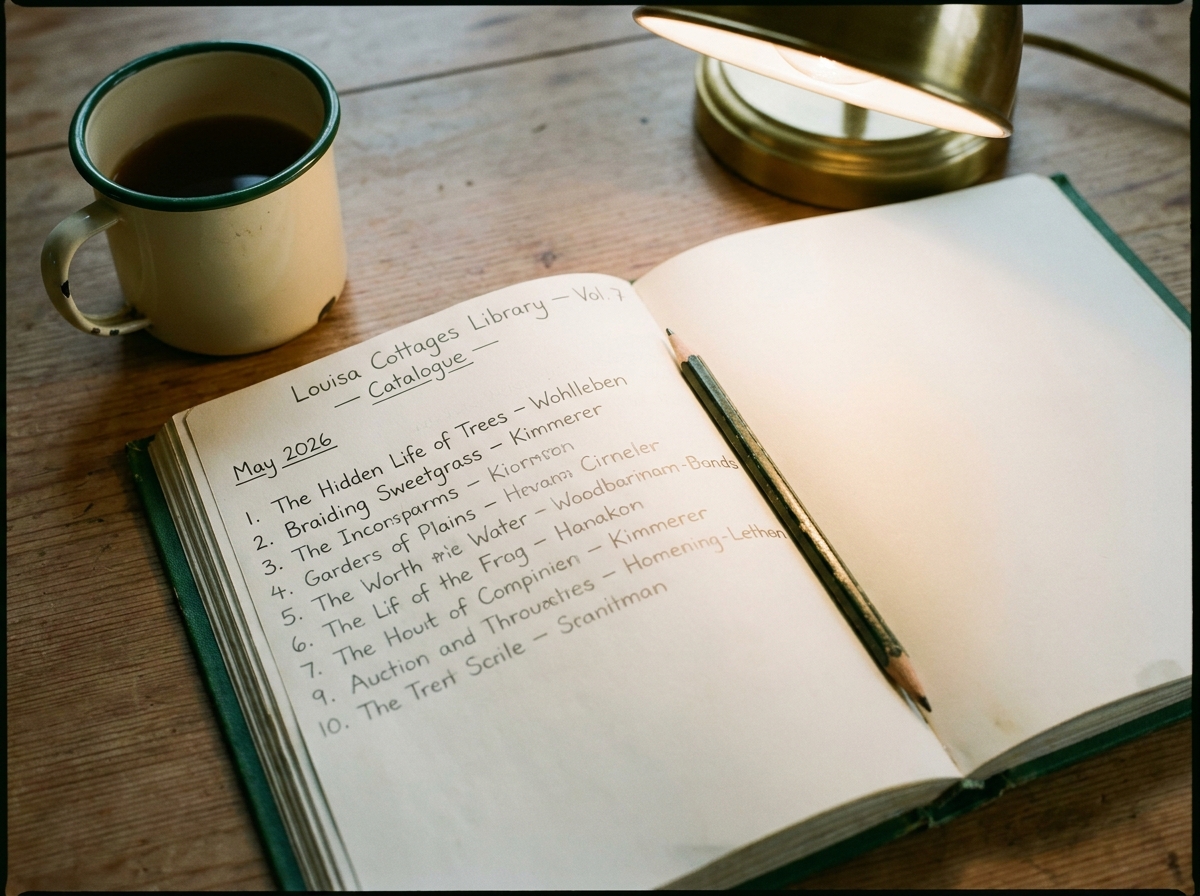
The catalogue is a green hardback notebook, hand-ruled in pencil. Each entry has the title, the author, the donor (if known), and a single column for the date borrowed, which Margaret marks with a pencilled tick when the book comes back. There are three hundred and twenty-one entries in the book at the time of writing. She has been doing this for seven of her eight years here.
When we ask Margaret why she keeps the catalogue, she says she likes the rhythm of it. She likes the way a Tuesday morning can have a purpose without being a full-time job. She is unsentimental about almshouse life. I don’t live here because I am poor, she says, I live here because I do not want to be alone in a three-bedroom house in the rain.
I keep the library catalogue because I like the rhythm of it. A Tuesday morning can have a purpose without being a full-time job.
Joseph, cottage five
Joseph is eighty-four, a former signalman on the line from Aylesbury to Marylebone, and the gardener-in-chief of the walled plot behind the south range. He has been with us for six years.
The garden is fifteen yards by twelve. It contains a low lavender border, two raised beds, a pear tree that nobody can date with any certainty (the consensus is ‘older than the south range’), and a single wooden bench. Joseph plants the broad beans in the second week of April, the runner beans on the first warm day after the May Day weekend, and the late lettuces in mid-July. He keeps the planting plan in his head and is patient with anyone who asks where the parsley is for the fourth time in a season.
He has a working partnership with two of our garden-companion volunteers, both of whom come on alternate Saturdays. The shape of the conversation, on those Saturdays, is a polite negotiation about what gets weeded, what gets left, and which of the two beds will host the courgettes this year. By common consent the bench is always to be reachable without stepping over a watering can.
Iris, cottage one
Iris is eighty-one, and has been at the cottages for three years. She moved here in late 2023, six months after her husband died, on the advice of her daughter and a small voice in herself that said she did not want to die in the same house. The clerk met her at the gate of cottage one with the front-door key and a kettle already on the boil; we had picked up a packet of her favourite biscuits from the Co-op two streets over. Iris remembers all of this.
She knits. Each autumn she makes a small batch of plain wool scarves, in heathered greys, for the cold-weather bag at our local surgery. Last winter she made twelve. The bag is the surgery’s arrangement: when a patient comes in poorly dressed for the weather, the nurse can give them a scarf to take home. Most of them are not returned. That, Iris says, is the point.
When Iris first came, our Sunday Doors team paired her with Eileen from cottage four, who has been here longer and knows the rhythm of the place. The pairing has worked unusually well, and the two of them now share a paper between them on a Sunday morning and pass it under the connecting door of the common room when each is done. We did not plan the connecting-door manoeuvre. It happened.
The work that holds the house
What Margaret and Joseph and Iris have in common, and what they share with the other five residents at the time of writing, is not particularly dramatic. It is the work of looking after a place quietly, week after week, in a way that almost nobody outside the cottages would notice. The catalogue is updated. The bench is reachable. The scarves go to the surgery. The kettle is on at half past three on a Wednesday because someone is coming.
The trust supports this in the simplest of ways. We keep the roof on; we keep the boilers running; we mend the back doors when the hinges slip; we pay the rates and the buildings insurance; we run the Sunday Doors pairings; and we sit at the table at the AGM in September and explain to anyone who comes how the money came in and where it went. The rest is the residents’ own work, and they do it without being asked.
If you ever pass the cottages on Akeman Street on a Tuesday afternoon — the day Margaret updates the catalogue — you will not see much. You will see a row of black doors and six small bay windows. Almost everything that matters about the place will be happening just out of sight, in a green notebook, on a back step, between a pair of knitting needles. We think that is roughly as it should be.